
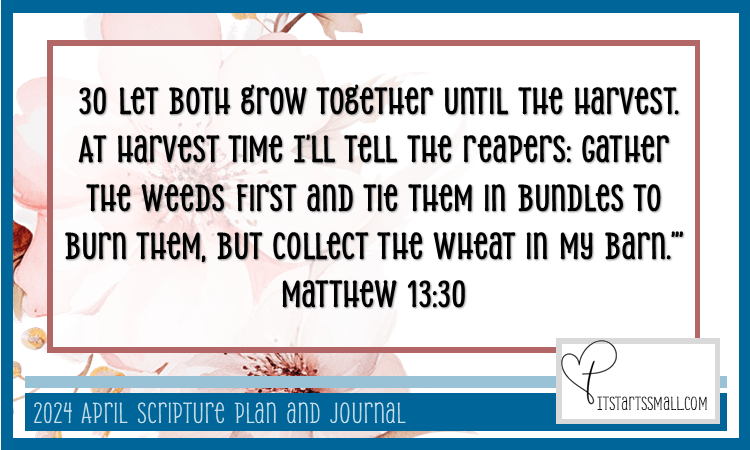
One of Satan’s most powerful tactics is to plant weeds in the church. Not a literal weed, but false teachers who dilute the Word of God This is the essence of Jesus’ parable.
24 He put another parable before them, saying, “The kingdom of heaven may be compared to a man who sowed good seed in his field, 25 but while his men were sleeping, his enemy came and sowed weeds among the wheat and went away. 26 So when the plants came up and bore grain, then the weeds appeared also. 27 And the servants of the master of the house came and said to him, ‘Master, did you not sow good seed in your field? How then does it have weeds?’ 28 He said to them, ‘An enemy has done this.’ So the servants said to him, ‘Then do you want us to go and gather them?’ 29 But he said, ‘No, lest in gathering the weeds you root up the wheat along with them. 30 Let both grow together until the harvest, and at harvest time I will tell the reapers, “Gather the weeds first and bind them in bundles to be burned, but gather the wheat into my barn.”’”
Matthew 13:24-30
The Greek word used to describe the weeds is not as broad as our English term. The Greek word is zizanion and means darnel or false grain:—tares. Tares were a plant that looked similar to grain but they had a black grain and not a normal colored grain. The Greek word referred to a worthless rye grass that would resemble wheat so closely they almost could not be distinguished. In this parable, Jesus is warning us that false teachers can be hard to identify.
5 having the appearance of godliness, but denying its power. Avoid such people.
2 Timothy 3:5
Paul teaches us to avoid people who appear godly but deny the power. How do we avoid them? Paul says:
3 If anyone teaches a different doctrine and does not agree with the sound words of our Lord Jesus Christ and the teaching that accords with godliness, 4 he is puffed up with conceit and understands nothing. He has an unhealthy craving for controversy and for quarrels about words, which produce envy, dissension, slander, evil suspicions, 5 and constant friction among people who are depraved in mind and deprived of the truth, imagining that godliness is a means of gain.
1 Timothy 6:3-5
False teachers deviate from God’s truth. We can draw from Jesus’ parable, we need to evaluate the fruit of someone’s life. Is it yielding love, joy, peace, and other fruit of the spirit? If not, is their life producing streams of arguments, corruption, greed, and trouble?
Better yet, let us turn the table on ourselves!
Are we producing love, joy, peace, and other fruit of the spirit? or are we producing arguments, corruption, greed and trouble?
Are we a tare or a wheat? Do we look like or we actually the real deal?
Need help?
Get in touch
it0starts0small@gmail.com
 It Starts Small
Leave a comment