
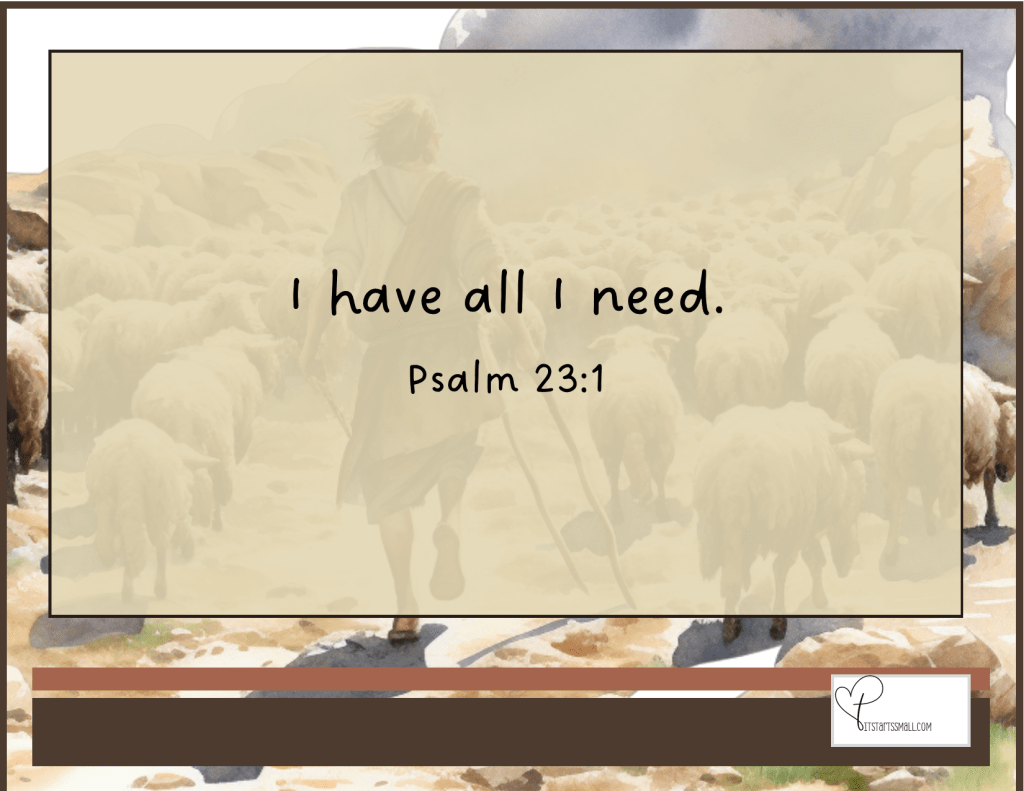
David has declared that God is His Shepherd and he has all he needs. That is a bold statement. How confident are we that we trust the Lord so much so we are completly content with what we have and believe we have all we need? The key word here is need. Let us look to God’s Word to understand what a need is and not get it confused with a want.
19 And my God will supply all your needs according to his riches in glory in Christ Jesus.
Philippians 4:19
What is a need?
To begin with, it helps to define what a need is. A need is something necessary and essential. For example, you need food and water because you will be malnourished and eventually die without it. That sounds like the definition of necessary and essential. With that definition, we can establish this verse’s foundational theme: God will supply you what is necessary and essential. This promise should comfort you and remind you of what Jesus said in Matthew.
31 So don’t worry, saying, ‘What will we eat?’ or ‘What will we drink?’ or ‘What will we wear?’ 32 For the Gentiles eagerly seek all these things, and your heavenly Father knows that you need them.
Matthew 31:32
You can be confident that God will supply what you need. He is aware of your situation and needs and will be faithful to provide for them.
There is another aspect of this promise that I want you to consider. You need to look at this passage in its full context. Before Paul writes these words, he commends the Philippian church for their generosity toward him.
“Yet it was good of you to share in my troubles. Moreover, as you Philippians know, in the early days of your acquaintance with the gospel, when I set out from Macedonia, not one church shared with me in the matter of giving and receiving, except you only; for even when I was in Thessalonica, you sent me aid more than once when I was in need.” (Philippians 4:14-16)
When Paul opens this letter to the Philippian church, he is thankful for their partnership in the gospel. As he is closing the letter, he reiterates his thanfulness. When Paul first went to Philippi, he preached to some women who had gathered to pray by the river. One woman listening to Paul was a businesswoman named Lydia. She responded to Paul’s message along with her household and began showing hospitality and generosity to Paul from that moment. She partnered with him from the very beginning of his ministry in Philippi.
When you understand that idea of partnership, you see another principle established here. God will care for your needs when you care for God’s work. I want to choose my words carefully because some have abused this principle. They have made erroneous statements, having people believe if you give to this ministry or “sow a seed,” God will return it to you many times over. That should never be the motivation or attitude with which you give.
You don’t give because God is going to give back to you. That’s not a partner. That’s an investor. This appeals more to people’s greed than their generosity. You should give generously, cheerfully, and willingly to support the work of the Lord without the thought of God giving back to you. When you give in this way, God will take care of your needs. This is what Paul desired for the Philippian church.
17 Not that I seek the gift, but I seek the profit[a] that is increasing to your account. 18 But I have received everything in full, and I have an abundance. I am fully supplied,[b] having received from Epaphroditus what you provided—a fragrant offering, an acceptable sacrifice, pleasing to God.
Philippians 4:17-18
Paul was not going after their gift because he acknowledged he had more than enough— especially with the last gift received from Epaphroditus. In response to their sacrificial giving, Paul says, “My God shall supply all your needs.” In this context, this verse promises God’s response to your giving. God supplies those who supply his work.
Again, this should not be used to get more money from people, as some unscrupulous people try to do. However, recognize that as you give what you can to support God’s work, you can do it with the full confidence of knowing God will supply what you need.
Clearly, this verse is not talking about material prosperity. For something to be a need, it must be necessary and essential. In this chapter, Paul does not focus on material blessings. If anything, he refers to contentment in every situation.
12 I know how to make do with little, and I know how to make do with a lot. In any and all circumstances I have learned the secret of being content—whether well fed or hungry, whether in abundance or in need.
Philippians 4:12
(Bold for emphasis)
This gives another perspective of God supplying all your needs. Sometimes the supply will be just enough, and sometimes the supply will be more than enough. Regardless of which one it is, we should always have a posture of contentment and thankfulness. We should never complain because we have just enough. We should be thankful that God has supplied. This can only happen when you view God supplying your needs from the right perspective.
If we are not careful, we can look at this verse with a sense of entitlement and miss the grace that is flowing in this verse. God provides because he is your Father. However, we can only become his children because of the sacrifice of Jesus Christ. Remove Christ from the equation, and this no longer works. When you realize that God’s provision is because of Christ and not because of you, you will appreciate how God supplies in your life. Whether that is just enough or more than enough.
I heard an old preach explain needs along the lines as this:
Is my petition essential to accomplishing God’s purpose, or is it only for my enjoyment?
If we can’t complete the Lord’s plan without something, then it’s a need, and He will answer when we pray for Him to fulfill that requirement.
I have all I need.
I shall not want.
No matter what version you read from this statement does not mean God gives us everything we want. The term want is a way of describing need. David affirms that we will never lack what we need. The Lord will always provide.
Jesus Christ taught that when we wonder whether or not God will meet our physical needs, we should ask ourselves a few questions from Matthew 6:25–30.
25 “Therefore I tell you: Don’t worry about your life, what you will eat or what you will drink; or about your body, what you will wear. Isn’t life more than food and the body more than clothing? 26 Consider the birds of the sky: They don’t sow or reap or gather into barns, yet your heavenly Father feeds them. Aren’t you worth more than they? 27 Can any of you add one moment to his life span by worrying? 28 And why do you worry about clothes? Observe how the wildflowers of the field grow: They don’t labor or spin thread. 29 Yet I tell you that not even Solomon in all his splendor was adorned like one of these. 30 If that’s how God clothes the grass of the field, which is here today and thrown into the furnace tomorrow, won’t he do much more for you—you of little faith?
Matthew 6:24-30
Does God not feed the ravens?
Does He not cause the lilies to grow?
How, then, can He leave his children to hunger?
What about our spiritual needs? Does our Shepherd provide for them too? Consider what Paul in 2 Corinthians 12:9:
But he said to me, “My grace is sufficient for you, for my power is perfected in weakness.”
You may wonder, how can I be absolutely confident that God will faithfully supply all my needs? Because He has already provided your greatest need—His Son as your Savior! There is hardly a more uplifting verse in all of Scripture than Romans 8:32:
He did not even spare his own Son but gave him up for us all. How will he not also with him grant us everything?
A Good Shepherd will always make sure the needs of His flock are taken care of!
Need help?
Get in touch
it0starts0small@gmail.com
 It Starts Small
Leave a comment