
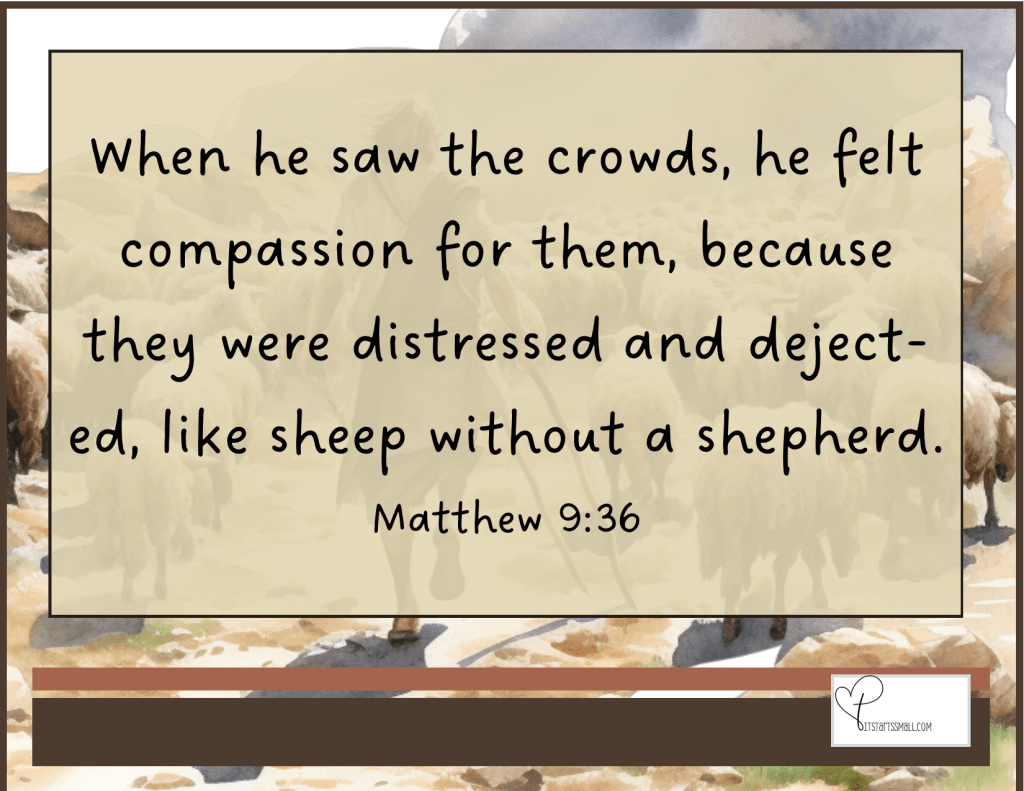
Our scripture today looks at another place where shepherds are mentioned. In this passage, Jesus is looking out at the people who have gathered to hear him preach.
Jesus’ teaching and miracles have drawn huge crowds. Some have travelled great distances to see Him. Earlier in Matthew, Jesus felt the need to get away from the crowds, escaping in a fishing boat all the way across the Sea of Galilee. In those specific moments, Jesus recognized the need to rest and refresh Himself.
In a broader sense, though, Jesus looks at the crowds of people and is filled with compassion for them. These are the children of Israel. These are the people of God. Instead of flourishing, Jesus sees that they are harassed and helpless. If Matthew had stopped there, we might think Jesus’ sympathy for them had to do with Roman occupation. Instead Jesus feels compassion for a specific kind of misery: symbolized by the image of lost sheep.
Lets look at other translations to see how the “lost” sheep were described:
When he saw the crowds, he had compassion on them, because they were harassed and helpless, like sheep without a shepherd.
Matthew 9:36 NIV
(Bold for emphesis)
But when he saw the multitudes, he was moved with compassion on them, because they fainted, and were scattered abroad, as sheep having no shepherd.
Matthew 9:36 KJV
(Bold for emphesis)
When he saw the crowds, he had compassion on them because they were confused and helpless, like sheep without a shepherd.
Matthew 9:36 NLT
(Bold for emphesis)
Confused, helpless, fainted, scattered, harassed, distressed, dejected.
The Greek words used to describe the people are the phrase: eklyō, which means to have one’s strength relaxed, to be enfeebled through exhaustion, to grow weak, grow weary, be tired out. The other word Greek phrase is: riptō, which means prostrated by fatigue, hunger.
Jesus saw the need these people had: physically, spiriutally, and emotionally. Jesus’ compassion and sympathy are another connection to God the Father (Psalm 103:13–14). His impulse to shepherd the people points again to the fact that He is the Messiah (Micah 5:4).
In the Sermon on the Mount (Matthew 5:1–2), Jesus challenged the attitudes and behaviors of Israel’s religious leaders in several important areas. This, though, is the greatest charge against them. Instead of shepherding the people of Israel with kindness and mercy, the Pharisees and the other religious leaders judge, intimidate, and bully the people into following rules and procedures not even found in the law of Moses. The people are helpless against these leaders, since their participation in the worship of God and life of the community is dependent on the approval of these men.
Are we glad we have the King of kings and Lord of lords to shepherd us! A good Shepherd understands the needs of the poeple and desires to lead them.
Today, do any of the words used to describe the people Jesus has compassion for resonate with you?
Confused, helpless, fainted, scattered, harassed, distressed, dejected.
Perhaps today, Jesus is patiently waiting for you to allow him to be your shepherd!
Need help?
Get in touch
it0starts0small@gmail.com
 It Starts Small
Leave a comment