
Yesterday we opened this series by looking at the first portion of Psalm 23:1: The LORD is my Shepherd. We contemplated what this means to us. How do we associate a shephard with God?
Today we are going to look at a passage of scripture in which Jesus, our Good Shephard, speaks:
Jesus lays out three analogies in the first half of this chapter. These are all centered on shepherding, a topic with which His audience would have been very familiar. These teachings are all separate. They carry slightly different symbolism and slightly different implications.
As we read this passage of scripture, take note of all references to shephard and the characteristics of a good shephard.
10 “Truly I tell you, anyone who doesn’t enter the sheep pen by the gate but climbs in some other way is a thief and a robber. 2 The one who enters by the gate is the shepherd of the sheep. 3 The gatekeeper opens it for him, and the sheep hear his voice. He calls his own sheep by name and leads them out. 4 When he has brought all his own outside, he goes ahead of them. The sheep follow him because they know his voice. 5 They will never follow a stranger; instead they will run away from him, because they don’t know the voice of strangers.” 6 Jesus gave them this figure of speech, but they did not understand what he was telling them.
John 10:1-6
First, Jesus points out that sheep only listen to the voice of their own particular shepherd. They won’t listen to a stranger. Spiritually, this explains why men like the scribes and Pharisees don’t accept Jesus: they are not part of “His” flock. In prior discussions, Jesus noted that these men are, ultimately, subjects of the Devil.
42 Jesus said to them, “If God were your Father, you would love me, because I came from God and I am here. For I didn’t come on my own, but he sent me. 43 Why don’t you understand what I say? Because you cannot listen to[a] my word. 44 You are of your father the devil, and you want to carry out your father’s desires. He was a murderer from the beginning and does not stand in the truth, because there is no truth in him. When he tells a lie, he speaks from his own nature,[b] because he is a liar and the father of lies. 45 Yet because I tell the truth, you do not believe me. 46 Who among you can convict me of sin? If I am telling the truth, why don’t you believe me? 47 The one who is from God listens to God’s words. This is why you don’t listen, because you are not from God.”
John 8:42-47
They don’t listen to the voice of God because they are part of some other flock. Unsurprisingly, Jesus’ detractors don’t get the point
7 Jesus said again, “Truly I tell you, I am the gate for the sheep. 8 All who came before me are thieves and robbers, but the sheep didn’t listen to them. 9 I am the gate. If anyone enters by me, he will be saved and will come in and go out and find pasture.
John 10:7-9
David’s experiences clearly show that shepherding in the ancient world was hardly safe (1 Samuel 17:34–37). Jacob’s struggles prove it was not easy (Genesis 31:38–40). Shepherds not only had to keep watch over the flock to prevent strays, but had to defend the sheep from animals like wolves and bears, as well as thieves.
The second analogy is relatively brief, but it carries enormous implications. Sheep pens of that era were constructed with high walls and a single narrow opening. This was the only legitimate means of entry or exit—a point Jesus also noted in the first analogy. To control access, the gatekeeper would stand or lay across the opening: he would physically serve as the door. Jesus claims to have that same role, spiritually: He is “the Door,” the one and only means by which sheep can enter the pen and find rescue from harm. This is the third of seven times in the gospel of John where Jesus uses the unique phrasing echoing the statement made by God in Exodus 3:14. The world, like sheep, can be divided into only two groups: those “in” and those “out,” as defined by “the Door,” which is Christ alone.
10 A thief comes only to steal and kill and destroy. I have come so that they may have life and have it in abundance.
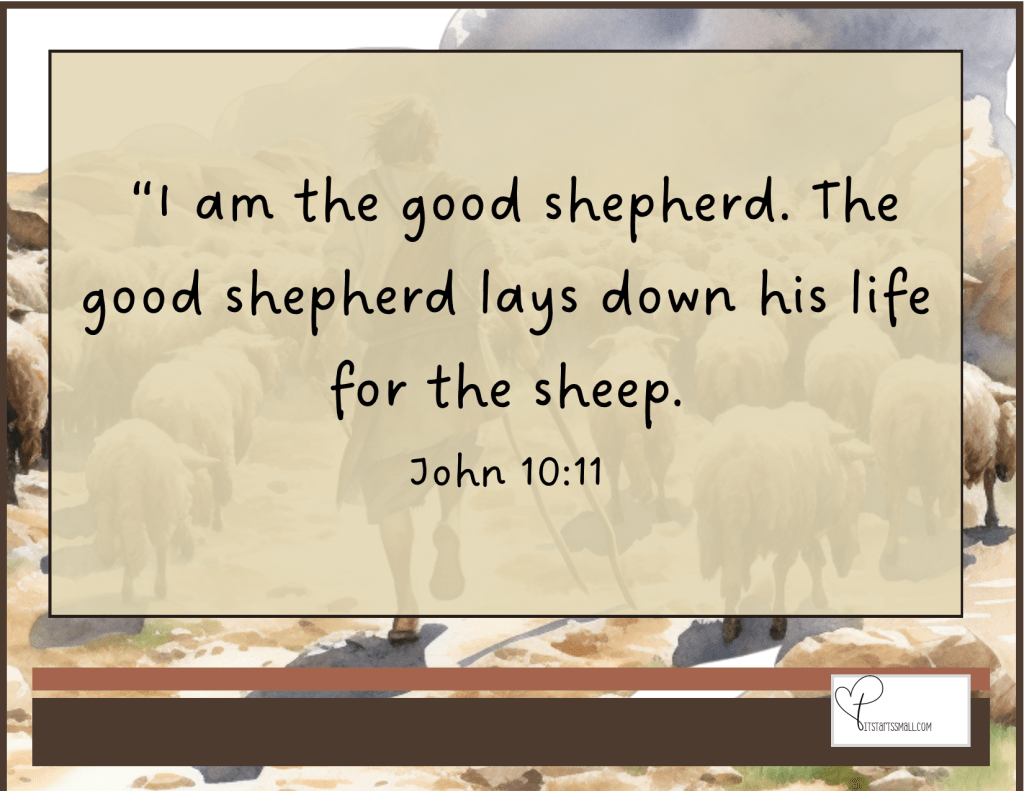
11 “I am the good shepherd. The good shepherd lays down his life for the sheep. 12 The hired hand, since he is not the shepherd and doesn’t own the sheep, leaves them and runs away when he sees a wolf coming. The wolf then snatches and scatters them. 13 This happens because he is a hired hand and doesn’t care about the sheep.
14 “I am the good shepherd. I know my own, and my own know me, 15 just as the Father knows me, and I know the Father. I lay down my life for the sheep. 16 But I have other sheep that are not from this sheep pen; I must bring them also, and they will listen to my voice. Then there will be one flock, one shepherd. 17 This is why the Father loves me, because I lay down my life so that I may take it up again. 18 No one takes it from me, but I lay it down on my own. I have the right to lay it down, and I have the right to take it up again. I have received this command from my Father.”
John 10:1-18
(Bold for emphesis)
Finally, Jesus refers to Himself as the “Good Shepherd,” as a contrast to the false religious leaders of Israel. He especially notes His willingness to die for the sake of the flock. Hired hands, as employees, only care for sheep until faced with personal risk. When in danger, they tend to run away. Unlike those false leaders, Jesus is willing to sacrifice Himself to save those He protects. In this comparison, Jesus once again uses the “I am” phrasing. This is the fourth time in the gospel of John where He highlights that theme. His statement also makes a clear, emphatic claim that those who are saved by faith in Jesus are saved permanently, and cannot be lost by any means.
Today’s scripture is the fourth of seven instances where Jesus evokes the “I AM” terminology which implies He is divine. This echoes the statement made by God to Moses through the burning bush.
God replied to Moses, “I AM WHO I AM. This is what you are to say to the Israelites: I AM has sent me to you.”
Exodus 3:14
This claim is separate from the “I am” statement made in verses 7 and 9. It is also a separate analogy—related, but not identical, to the first two Jesus spoke in this chapter. Here Jesus claims to be “the good shepherd,” using the Greek phrase hokalos. This suggests the ideal, the pinnacle, or the perfect example of something.
In this analogy, Jesus again contrasts Himself with the selfish, ungodly religious leaders who so often prey on other people. They, like a thief, use illicit means and wreak havoc on the flock, all for their own gain. Jesus offers life and in abundance.
A thief comes only to steal and kill and destroy. I have come so that they may have life and have it in abundance.
John 10:10
Maintaining this contrast, Jesus frames Himself as “the Good Shepherd,” who puts His life on the line for the flock. Jesus’ religious critics, such as the scribes and Pharisees, were by extension “bad” shepherds, unwilling or unable to truly care for those they claimed to serve.
At the same time, Jesus’ words here foreshadow the idea that His earthly purpose is to die on behalf of His “sheep.”
There are many things to reflect upon today, but let us ponder on who truley shepherds our lives. Which side of the gate are we truly on?
Need help?
Get in touch
it0starts0small@gmail.com

 It Starts Small
Leave a comment