
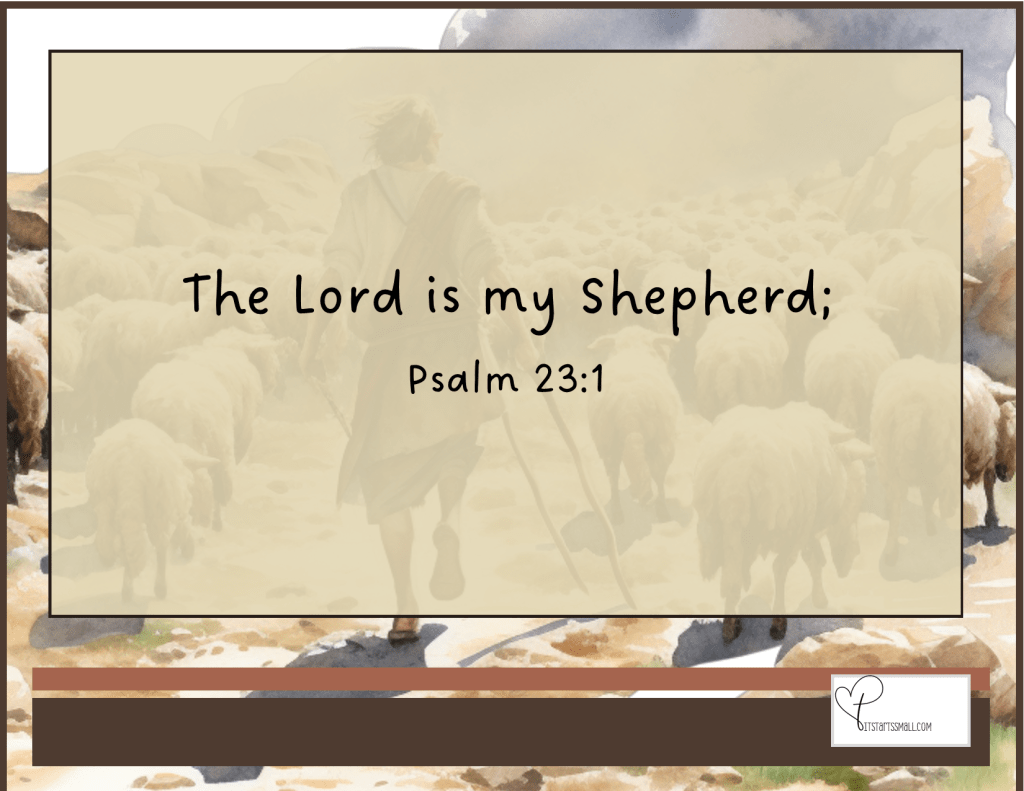
There is all sorts of theological debate on when David wrote this Psalm. There is speculation he wrote it when he was in a very distressing situation. When we read through David’s life, there is a rare occasion he was not in trouble of some sort. Some he, himself, caused, and others came from not just his enemies, but enemies of the Lord. It has also been speculated that he wrote this Psalm while on the run from Saul. Another thought is he wrote it in the forest of Hareth. Still, some theroize he wrote it at the end of his life.
No matter when David wrote this Psalm, we find that David is comforting himself with the Lord being his shepherd. He has all he needs and has no fear because his Shepherd provides and comforts.
What I have found facinating is that this psalm was meant to be uplifting and joyful, but in today’s world it is centered mostly around funerals. One of life’s most devestating circumstances is to be at the grave site of someone you love and as the casket is being lowered, the officiant begins quoting this passage of scripture. I recently watched this on a movie. I paused the movie and sat there pondering. Perhaps traditionalism relates this psalm to those still on earth that this is the dark valley and it is to be a comfort to those grieving and mourning.
Psalm 23 has over the years inspired a lot of people as it gives hope, assurance and guidance. Many people have sought to draw inspiration from this passage as a source of protection from their enemies. This memorized passage continues to remain universally relevant as it has been acclaimed as a source of comfort to many.
Let’s examine this powerful passage as it will seek to reveal the unconditional love that God has for mankind by constantly meeting their needs, even during their dark valley experiences.
David chose to use a universal profession, by his knowing or not. Shepherding is not a mystery. While moderation has improved the conditions of shepherds, our world is still full of those who look after a herd of animals. ONe thing that remains consistant to shepherds, the animals have not changed, but the methods have. For example, in western civilations, the moving of herds consists of the use of horses and ATVs or one or the other. In biblical times, they walked everywhere they went. The goal was and is still the same: shepherding.
Before David was ever annointed by God as king, he was a shepherd.
11 Samuel asked him, “Are these all the sons you have?”
“There is still the youngest,” he answered, “but right now he’s tending the sheep.” Samuel told Jesse, “Send for him. We won’t sit down to eat until he gets here.” 12 So Jesse sent for him. He had beautiful eyes and a healthy, handsome appearance.
Then the Lord said, “Anoint him, for he is the one.” 13 So Samuel took the horn of oil and anointed him in the presence of his brothers, and the Spirit of the Lord came powerfully on David from that day forward. Then Samuel set out and went to Ramah.
1 Samuel 16:11-13
Before David stood before Goliath, he was tending his father’s sheep when he was sent to the battle to give his brothers provisions.
12 Now David was the son of the Ephrathite from Bethlehem of Judah named Jesse. Jesse had eight sons and during Saul’s reign was already an old man. 13 Jesse’s three oldest sons had followed Saul to the war, and their names were Eliab, the firstborn, Abinadab, the next, and Shammah, the third, 14 and David was the youngest. The three oldest had followed Saul, 15 but David kept going back and forth from Saul to tend his father’s flock in Bethlehem.
16 Every morning and evening for forty days the Philistine came forward and took his stand. 17 One day Jesse had told his son David, “Take this half-bushel of roasted grain along with these ten loaves of bread for your brothers and hurry to their camp. 18 Also take these ten portions of cheese to the field commander. Check on the well-being of your brothers and bring a confirmation from them. 19 They are with Saul and all the men of Israel in the Valley of Elah fighting with the Philistines.”
20 So David got up early in the morning, left the flock with someone to keep it, loaded up, and set out as Jesse had charged him.
1 Samuel 12-20
So we can conclude that as David speaks about the shepherd, he has good authority to speak of what a shepherd is, because for a time he was.
In the Bible, shepherds are often used as metaphors for leaders of God’s people. Shepherds are responsible for the safety, guidance, and provision of their flock. They protect their sheep from predators, watch for enemies, and defend them when necessary. Shepherds also tend to sick or wounded sheep, and search for and rescue lost or trapped ones.
Some qualities of a good shepherd in the Bible include: Entering by the gate, Knowing and caring for the sheep, Laying down their life for the sheep, and bringing the sheep abundant life. In the Gospel of John, Jesus refers to himself as the Good Shepherd, saying, “I am the good shepherd: the good shepherd giveth his life for the sheep,” and “I am the good shepherd, and know my sheep, and am known of mine”. Jesus is depicted as the guide, protector, healer, and shepherd of his sheep, who need spiritual food, care, mercy, and healing.
SO before we dive into this Psalm, let us ask ourselves:
How does the shepherd’s role in verse 1 relate to your understanding of God?
Need help?
Get in touch
it0starts0small@gmail.com

 It Starts Small
Leave a comment