
God’s Word provides detailed explanation of Heavenly wisdom, which leads to godliness, or earthy demonic wisdom which leads to corruption.
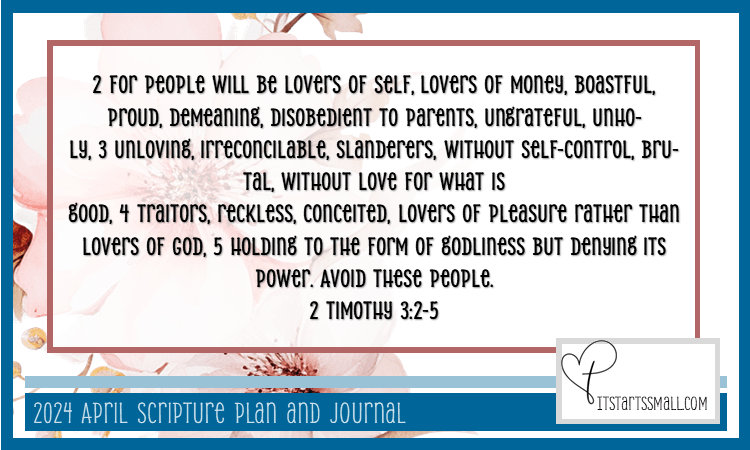
In these 4 scriptures, Paul gives 19 attributes found in evil people.
- Selfishness: people will be selfish, rather than serving others.
- Obsession with wealth: Material things are not evil in and of themselves, but the love of money is a root of all kinds of evil.
- Proud: meaning they are preoccupied with people noticing them and their actions. This is related to concepts such as arrogance, but puts the expectation on others. A “proud” person not only thinks highly of themselves, they expect other people to demonstrate approval.
- Arrogant: This is from the Greek word hyperēphanoi, literally meaning “putting one’s self above others.” This term seems to refer more to one’s state of mind, while the idea of “selfishness” involves a similar problem, but in deeds.
- Abusive: The Greek word used here refers to speaking slander or evil of others: blasphēmoi.
- Dishonor their Parents: these wicked ones would break the commandment to honor one’s parents (Exodus 20:12). This is a common thread in the lives of those who despise authority. Children who do not respect their parents typically do not respect anyone. Those who do not honor their parents, in this context, have problems beyond simple family conflict.
- Ungrateful or unthankful: This closely relates to the ideas of selfishness and arrogance; those who are ungrateful typically feel entitled to certain things—rather than being thankful when they receive, they are angry when they do not.
- Unholy: not truly desiring to live according to God’s truth. God is described in the Bible as “holy,” which means “set apart” (Exodus 15:11; Isaiah 6:3). In contrast, these evil people are unholy, immersed in the fallen world. This echoes an illustration Paul used in 2 Timothy 2:20–21.
- Heartless: from the Greek astorgoi. This term is the combination of the negative a, meaning “not” or “against,” with the root word storge. That Greek root word refers to a natural, affectionate love. Storge is typically summarized as “parental love.” In this context, it not only means those who fail to show proper love to children. It also means those who are inhumane towards others.
- Unappeasable: from the Greek word aspondoi. This means those who refuse to hold to agreements, who cannot be convinced to agree on anything. Some translations use the word “irreconcilable.”
- Slanderous: This Greek term is diaboloi, which means one who lies, slanders, or makes false accusations. This is the root of English words such as diabolic. From a Christian standpoint, this is one of the titles of Satan: “The Devil,” meaning the one who lies and slanders others. A hallmark of this fallen world is the tendency to tear down others with gossip, lies, and hateful speech.
- Without self-control: Self-control is part of the fruit of the Spirit (Galatians 5:22–23). The presence of self-control is mentioned frequently by Paul as an important trait in the life of a Christian (1 Corinthians 7:5, 9; 9:25; Galatians 5:23; 1 Timothy 2:9, 15; 2 Timothy 1:7). Self-control implies a person who is not selfish or arrogant, as mentioned in verse 2.
- Brutal: from the Greek word anēmeroi. This most literally means “savage or untamed.” Paul’s use of it here might refer to physical violence, but it certainly implies a wild and un-controlled attitude.
- Hatred for godly things: the Greek word aphilagathoi, which suggests a very personal aspect to this hate. In other words, these evil people do not merely despise “goodness,” they specifically dislike “good people.” This certainly agrees with Jesus’ warning to the disciples: those who love God will be hated by the world (John 15:18–21).
- Treacherous or traitors: Prior verses mentioned these people as “irreconcilable,” or “unappeasable” (2 Timothy 3:3), meaning those who cannot be convinced to agree or to honor an agreement. The accusation here is similar, but more focused on one’s behavior. “Traitors” are those who actively work against the interests of their so-called friends and allies.
- Reckless: which includes the idea of not thinking before acting, or acting in a thoughtless manner. This is the “ready-fire-aim” mentality, one which is incompatible with higher ideals such as self-control.
- Conceited: The original Greek description is tetyphōmenoi, which literally means to surround with smoke or mist. As a metaphor, this was used to describe someone who was blinded by their own sense of self-worth. This ties in closely to the concepts of arrogance and recklessness mentioned earlier in the passage. The ungodly often blind themselves through their own actions. This term is sometimes translated as “puffed up” with pride.
- Concerned with hedonism and entertainment than with the will of God: This is an overwhelmingly common barrier to faith in the gospel. Many people reject the idea of Christianity on the grounds that they would have to “give up” certain sinful pleasures. This, as other terms in Paul’s list suggest, is a near-sighted and ignorant assumption. In truth, nothing is more freeing that saving faith in Christ (John 10:10).
- A Window dressing of faith in God, but rejecting the actual power of the Holy Spirit. This echoes Paul’s condemnation of evil in Titus 1:16. In other words, these wicked ones want to be seen as good people, or as spiritual people, or as teachers, but were not truly following God (1 Timothy 1:3–7). They had religion, but they did not have a legitimate relationship with God built upon truth (2 Timothy 3:16–17). This would also include those who overtly pick and choose when to obey God, and when to dismiss His message.
After Paul gives us a lengthy description, he gives solid simple blunt advice:
AVOID THESE PEOPLE 2 Timothy 3:3
While keeping away from immorality is important in general, Timothy is to specifically steer clear of those who claimed to follow God yet denied it through their false actions and teachings. It’s particularly important for Christians to demonstrate a clear separation from those who claim to be Christians but whose actions say otherwise.
Before we ever look at others….we best be looking at ourselves and weighing this list against our own actions and behaviors. What on this list do we know we are guilty of?
If you are following along in the Journal, the back pages have a table of Heavenly Wisdom vs. Corrupted Wisdom. Today’s scripture is in the blocks under the column Corrupted Wisdom. If you get stuck, you can visit this page and see my example.
Need help?
Get in touch
it0starts0small@gmail.com
 It Starts Small
Leave a comment