
God’s Word provides detailed explanation of Heavenly wisdom, which leads to godliness, or earthy demonic wisdom which leads to corruption.
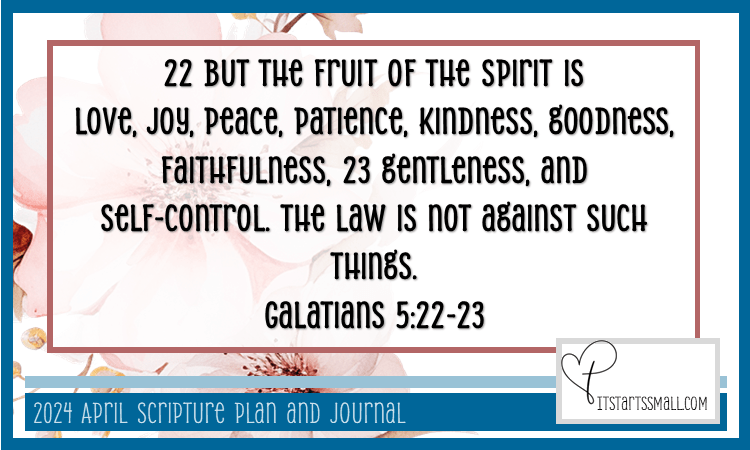
As we continue to journey through God’s Word and look at heavenly wisdom, we look at a famous passage of scripture from Paul in Galatians. He is teaching us the fruit of the Spirit. WHen we want to see a picture of what godliness looks like we can look no further than Galatians 5:22-23. Here Paul is teaching us what the lives of those who are free in Christ should look like. How are we to live if we are not under the law of Moses?
Earlier in this chapter Paul says that our lives are not to be squandered:
For you were called to be free, brothers and sisters; only don’t use this freedom as an opportunity for the flesh, but serve one another through love. 14 For the whole law is fulfilled in one statement: Love your neighbor as yourself. 15 But if you bite and devour one another, watch out, or you will be consumed by one another.
Galatians 5:13-15
Freedom in Christ is freedom from the law. Paul says we remain under the law when we chose to only serve ourselves. Paul then gives us a laundry list of sinful lifestyles. We will cover this in a few days when we look at the corrupted wisdom of the world. But Paul also says that whose in Christ should not squander their lives and that those in Christ should allow the Holy Spirit to lead them into powerful service to others motivated by love.
Paul then continues in our scriptures for today. He offers us a new list that describes what those in Christ should expect to see flowing from their lives when the Holy Spirit is in control and leading them. Paul calls them the fruit of the Spirit. Notice Paul does not say they are the fruit”S” – fruits – of the Spirit. These nine characteristics are not individual but all together. You do not see one of them and none of the rest. The flow all together. The do not have a particular order, rank, or schedule. The Holy Spirit is ALL of these at once and working ALL at once through us.
Love: Paul begins with love and in the Greek it is our famous term agapē. This type of love is “selfless love,” or an attitude that considers other people more than ourselves, without expecting anything in return. God’s Spirit in us produces God’s unconditional love in us for Him and for others (1 Corinthians 13:4–13). Love comes from no where else but the Holy Spirit.
Joy: Joy is translated from the Greek chara. It does not necessarily imply happiness. “Joy,” in a biblical sense, is best described as an inner confidence. Joy allows us to declare to our soul that all is well with us, now and forever, because of our place in Christ. Supernatural peace comes as a result of trusting God and is not dependent on our circumstances (Philippians 4:4–9).
Peace: Peace is the concept of restful, assured stillness. This is different from something frozen or fearful. It’s not the same as being restrained, nor does it mean a lack of motivation. Biblical “peace” involves emotions such as assurance, and an overall sense of spiritual calm.
Patience or Endurance: Patience is the ability, in the Spirit, to wait on God’s perfect timing even when our personal agenda seems to be failing. Paul uses the Greek term makrothymia. It gives the idea that “patience” includes controlling our response to circumstances. This contrasts with the error Paul gave in verse 20, translated “fits of anger,” from the related word thymoi. Scripture uses the term “patience” to mean an ability to endure hardship—to “weather the storm.”
Kindness: Kindness may be simple, but it is not always easy. Paul uses the Greek term chrēstotēs, which includes concepts of being good and gentle. In the Spirit, we can be kind to anyone, even those who are challenging and offensive. Kindness is not like niceness. Niceness is selective, but kindness does not limit.
Goodness: Goodness is the ability to do the right thing in every circumstance. Paul uses the Greek term agathōsynē and it implies a moral decency: this describes someone respectable, honorable, and righteous.
Faithfulness: Faithfulness is a crucial word, Paul uses the Greek term pistis, which simply as “faith” in the New Testament. This represents a kind of endurance, driven by trust. In the Spirit, Christ followers can keep going in the right direction, even when we don’t fully understand all God is doing.
Jesus said something very important to us:
16 You’ll recognize them by their fruit. Are grapes gathered from thornbushes or figs from thistles? 17 In the same way, every good tree produces good fruit, but a bad tree produces bad fruit. 18 A good tree can’t produce bad fruit; neither can a bad tree produce good fruit. 19 Every tree that doesn’t produce good fruit is cut down and thrown into the fire. 20 So you’ll recognize them by their fruit.
Matthew 7:16-20
Do people know us by these nine fruit?
Are we better known for thistles?
If you are following along in the Journal, the back pages have a table of Heavenly Wisdom vs. Corrupted Wisdom. Today’s scripture is in the first block under the column Heavenly Wisdom. If you get stuck, you can visit this page and see my example.
Need help?
Get in touch
it0starts0small@gmail.com
 It Starts Small
Leave a comment