
We continue to the last portion of verse 4.
who despises the one rejected by the Lord
Psalm 15:4
but honors those who fear the Lord,
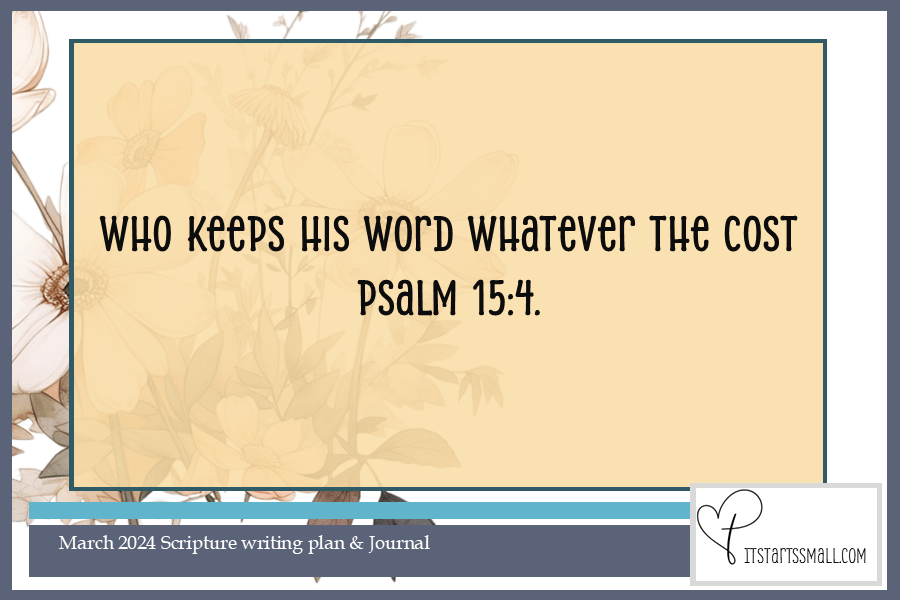
who keeps his word whatever the cost,
David is giving us opportunity to do some deep holy introspection. Verse 4 is an introspection of looking at our attitude. We despise the practice and doing sin. We choose to intentionally try to keep our eyes upon Jesus and we do our best to not make sin a healthy habit in our lives. We honor those who fear the Lord and rather than giving our ear to the world.
If we want to worship and be in the presence of God, we are people who will keep their word, no matter the cost.
A man who allows God to fill him with righteousness is a man that promises and engages upon oath to do something which may be beneficial to his neighbor, but apparently will be to his own damage. An example of this is if a man solemnly swear that he will sell his neighbor such an estate at a price below the full worth. Another example is giving a poor man such a sum of money, to give which afterward he finds inconvenient to him. He swears to do something, even though he experiences loss. He does NOT change His mind but continues firm, and resolved to preform his promise.
Above all, my brothers and sisters, do not swear, either by heaven or by earth or with any other oath. But let your “yes” mean “yes,” and your “no” mean “no,” so that you won’t fall under judgment.
James 5:12
James was pretty clear about making when we speak. We talk in terms of vows and promises but you do not have to use the words vows or promises. Anytime you voluntarily say you are going to do or not do, it is a vow. In Ecclesiastes, Solomon warns us that vows should not be made lightly:
Do not be hasty to speak, and do not be impulsive to make a speech before God. God is in heaven and you are on earth, so let your words be few.
Ecclesiastes 5:2
In verse 4 and 5, he cautions us:
When you make a vow to God, don’t delay fulfilling it, because he does not delight in fools. Fulfill what you vow. Better that you do not vow than that you vow and not fulfill it.
Ecclesiastes 5:4-5
It is better, the wise man counsels, not to vow at all, than to vow and fail to pay. This echoes Deuteronomy 23:22 where Moses informs Israel it is not sin to abstain from vowing: “But if you refrain from vowing, you will not be guilty of sin.”
On the other hand, if you vow and fail to pay, it is sin.
But if you refrain from making a vow, it will not be counted against you as sin.
Deuteronomy 23:22
Not only is it sin, but Solomon warns, “Let not your mouth lead you into sin, and do not say before the messenger that it was a mistake. Why should God be angry at your voice and destroy the work of your hands?” (Eccl 5:6). In other words, God punishes those who break their vows. Claiming that you made a mistake and shouldn’t have vowed or didn’t really mean what you vowed arouses God’s anger against you. Thus, Solomon concludes: Fear God (Eccl 5:7).
One of God’s most wonderful characteristics is that He IS faithful in every promise He makes to us. He expects us to do the same! Our integrity is on the line every time we say we will do something and then do not do it.
Today let us ponder how careful we need to be when we say we are going to do something and then do not do it. Have you broken a “vow” or a promise?
Do you make good commitments? Do you keep them no matter what?
Need help?
Get in touch
it0starts0small@gmail.com

 It Starts Small
Leave a comment