

Psalm 15 is a short 5 scripture psalm written by David. In the very first verse David asks two of the same questions:
Lord, who can dwell in your tent?
Who can live on your mountain?
There is much debate, as always, as to when David write this Psalm. There is no precise occasion, but it may have been when the ark was being returned to Jerusalem (2 Samuel 6).
David’s question is figurative. When we look at the context of the OT, we know that David is not a priest. He was permitted according to the Old Covenant to enter into the Holy of Holies as He was not a priest.
The word abide is the Hebrew word for gûr and means to sojourn, abide, dwell in, dwell with, remain, inhabit, be a stranger, be continuing, surely. The tabernacle of God was the great meeting tent God told Moses to build (Exodus 24-31). It was a huge massive moving tent. As they would wander the desert it would be build to God’s specifications. Then when they would move, it would be taken down and carried to the next place and rebuilt. It survived many centuries. In David’s time it seems to have been at Gibeon (1 Chronicles 16:39-40).
The Tabernacle was a place where man met God. Through the work of priests and the practice of sacrifice, David’s longing to abide in your tabernacle was actually a desire to abide in the presence of God. David had in mind, a life that a life that lived in the presence of God. He desired to walk close to and fellowship with God because the heart, mind, and life are all in step with the heart, mind, and life of God.
Then David asks again, but this time the use of dwell is more of a permanent use. It is as if David writes, who may be your guest? Who may enjoy all the hospitalities of God?
As David opens with question, He answers them in the next four verses and we are going to focus in on those verses to find out who can dwell within the presence of God? We are going to use these next verses to self-examine ourselves. What are we looking for? We are looking for our own unrighteousness. Anything in our hearts that is not of God. Remember, God is our righteousness. If it is not from Him, it is time to toss it out. Sweep it out. Clean it out.
Examining: Our Actions
The first category is examining our actions. People who worship God and want to be in His presence:
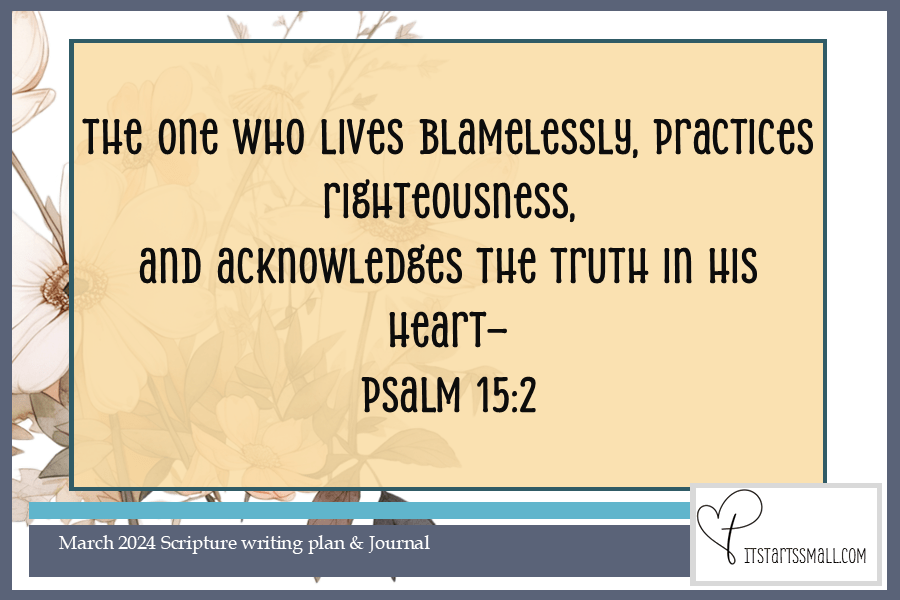
he one who lives blamelessly, practices righteousness,
Psalm 15:2
and acknowledges the truth in his heart—
They lead blameless lives and it is an indication to others that watch them and find them a convincing illustration of God’s holiness.
They do what is right means they have a standard outside themselves by which they abide — and that standard did not come from anyone BUT God.
They speak truth from sincere hearts in a way of saying that they do not self deceive — they allow God’s truth to train them.
This person is walking in the light. John tells us:
5 This is the message we have heard from him and declare to you: God is light, and there is absolutely no darkness in him. 6 If we say, “We have fellowship with him,” and yet we walk in darkness, we are lying and are not practicing the truth.
1 John 1:5-6
This person IS NOT PERFECT in any way, but strive to treat others well, abides by God’s precepts, and and is honest with themselves about all of it.
Lets examine our hearts today by asking ourselves some tough questions:
Does my calendar look like it belongs to someone who is surrendered and devoted to Jesus?
What is the area of my character the Holy Spirit wants me to address?
What do I continually justify in my life that I shouldn’t?
Need help?
Get in touch
it0starts0small@gmail.com
 It Starts Small
Leave a comment